
Location

Book a Tour

For Parents

Contacts
Location
Book a Tour
For Parents
Contacts

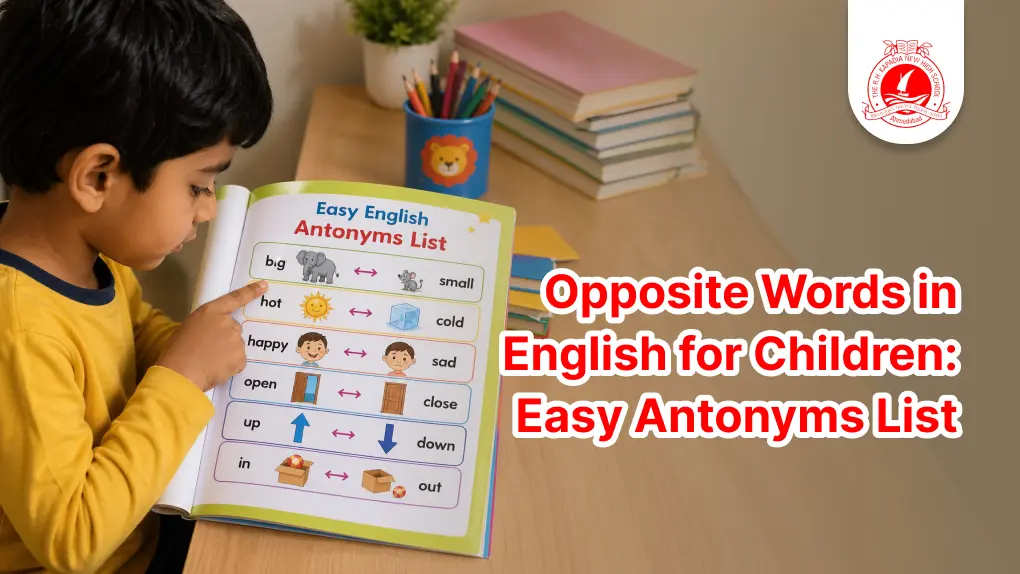
By age 8, kids’ minds are fully developed, and it is a crucial time when their thinking, learning, and cognitive skills are evolving. Early childhood care and education (ECCE) helps in the overall development of the child. During this period, it’s highly crucial that they understand and respond actively. Therefore, teachers and parents are always keen to introduce new concepts to children that naturally help them develop vocabulary, comprehension, and thinking skills.
One such theory is the integration of opposite words for class 1 students. In this blog, we will discuss 50 opposite words in English, also known as Antonyms, and how pre-primary toddlers benefit from them. Moreover, we will provide the importance of helping parents teach opposite words at home in a fun and engaging way.
| Word | Opposite Word | Example |
| Big | Small | Ants live in small holes. |
| Hot | Cold | Winters are cold. |
| Fast | Slow | The turtle is slow. |
| Happy | Sad | She feels sad today. |
| Shiny | Dull | Her uniform is dull. |
| Up | Down | Please sit down. |
| In | Out | The cat jumped out of the window. |
| Give | Take | Take a cookie from the jar. |
| Brave | Coward | Do not be a coward. |
| Happy | Sad | She feels sad today. |
| Shiny | Dull | Her uniform is dull. |
| Up | Down | Please sit down. |
| In | Out | The cat jumped out of the window. |
| Give | Take | Take a cookie from the jar. |
| Brave | Coward | Do not be a coward. |
| Thick | Thin | The paper is very thin. |
| Open | Close | Please close the door. |
| Day | Night | We sleep at night. |
| Light | Dark | The room is dark. |
| Tall | Short | The tree is short. |
| High | Low | The fuel is running low. |
| Full | Empty | The glass is empty. |
| Entrance | Exit | Walk towards the exit gate. |
| Laugh | Cry | The baby is crying. |
| Wet | Dry | The towel is dry. |
| Near | Far | The little bird flew far away. |
| Young | Old | The dog is getting old. |
| Clean | Dirty | Wash your dirty hands. |
| Normal | Strange | He gave me a strange look. |
| Long | Short | This rope is too short. |
| Loud | Quiet | Please be quiet. |
| Hard | Soft | The pillow is soft. |
| Inside | Outside | Let’s play outside the home. |
| Above | Below | The keys are below the table. |
| Deep | Shallow | Put the milk in a shallow dish. |
| First | Last | She came last in the race. |
| Same | Different | The bags are different. |
| Left | Right | Turn right to view the tulip garden. |
| Front | Back | Sit in the back row. |
| Smooth | Rough | The stone is rough. |
| Rich | Poor | NGO provides food to poor families. |
| Sweet | Sour | Lemons are sour in taste. |
| Huge | Tiny | The baby wore tiny blue shoes. |
| Start | Stop | The bus stopped at the corner. |
| Wide | Narrow | The road is narrow. |
| Early | Late | Don’t be late for swimming class. |
| Strong | Weak | He is weak. |
| Together | Apart | They sit apart. |
| Push | Pull | Pull the rope. |
| Begin | End | The game will end in an hour. |
| Go | Stop | Stop the car. |
| Open | Shut | Shut the box. |
| Bright | Dark | The room is dark. |
| Clean | Messy | The room is messy. |
| Full | Empty | The bag is empty. |
| Fast | Slow | Ride slowly to avoid road accidents. |
| Happy | Sad | The child is feeling sad. |
Learning opposite words for a child helps develop understanding, contrasting, and comparing skills. Words like hot and cold, big or small, help kids understand how ideas relate to each other in everyday situations. It helps in:
To Wrap Up
Opposite words are a core element of English grammar. It helps students and kids compare and expand their English vocabulary. Moreover, close coordination between teachers and parents helps kids improve focus and grasp the concepts being taught. More than forcing anything on your kids, you need to invest in building their foundation, and this is only achieved when kids get a collaborative environment. RHK Kids pre-primary school understands the importance of this and is keen to make learning interactive and fun for toddlers and students. These opposite words are helpful for nursery and UKG students.

Content Writer


 Admission Form For Pre-primary Section
  DOWNLOAD
 Nr Super Society, Ramdev Nagar, Satellite, Ahmedabad, Gujarat 380015
 +91-79-26920026, +91-79-40322444/45/46
 info@rhkkids.com